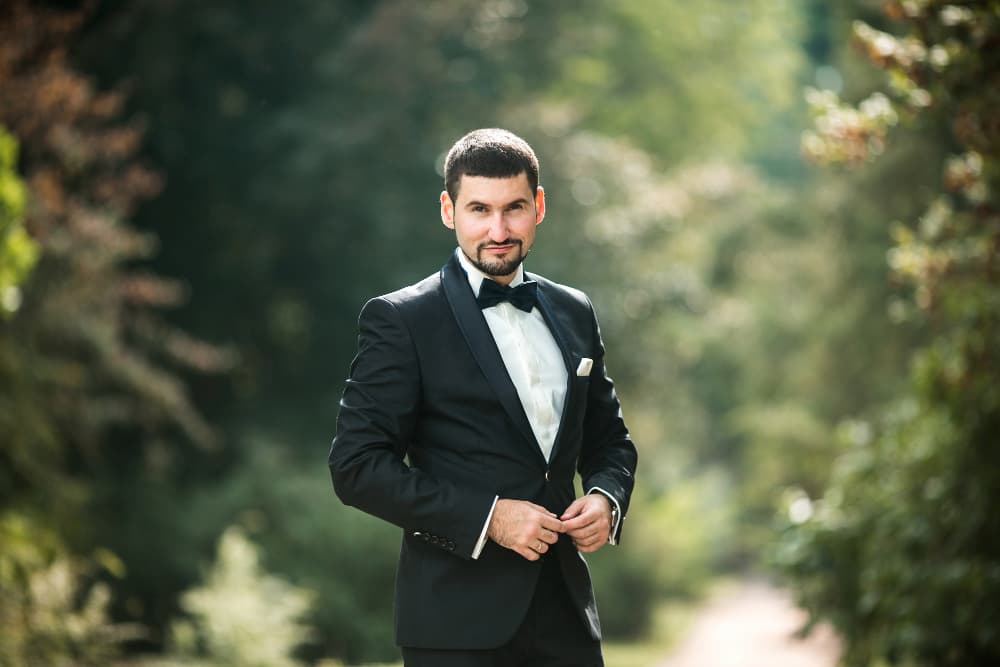
The Traditional Framework
At its core, black tie is built on consistency.
The standard elements include:
- A black tuxedo with peak or shawl lapels
- A crisp formal shirt
- A black bow tie
- Minimal accessories, chosen with restraint
This structure still defines formal evening wear. For strictly formal events, a well-executed bespoke tuxedo in Dubairemains the most appropriate choice.
Where the Shift Begins
The change is not in what black tie is—but in how it is applied.
Today, many events labeled “black tie” allow for:
- Subtle variation in colour
- Softer construction
- Personal interpretation in detailing
This shift reflects a broader change in how people approach formalwear—less about strict adherence, more about controlled flexibility.
Colour: Expanding Beyond Black
While black remains the standard, it is no longer the only option.
Midnight blue, deep charcoal, and even darker shades of green or burgundy are increasingly accepted in certain settings.
These variations:
- Maintain a formal presence
- Offer visual depth under evening lighting
- Allow differentiation without breaking the dress code
For clients exploring custom suits in Dubai, this opens up options that remain appropriate while offering a more considered look.
Fabric and Texture
Modern black tie is also seeing a shift in fabric choices.
Instead of relying solely on smooth, traditional finishes, there is growing use of:
- Subtle textures
- Matte weaves
- Lightweight fabrics suited to the climate
In the UAE, where comfort plays a role even in evening events, selecting lightweight suit fabric in the UAE ensures the garment remains wearable throughout long functions.
Structure: Moving Towards Ease
Traditional tuxedos were built with firm structure, designed to hold a fixed silhouette.
Today, there is a move towards:
- Softer construction
- Reduced internal weight
- Greater ease of movement
This does not reduce formality—it adapts it.
A well-constructed tuxedo should still hold its shape, but it should also allow the wearer to move comfortably across extended events.
The Role of Fit
As dress codes become more flexible, fit becomes even more critical.
When colour and styling begin to vary, the focus shifts to how the garment sits on the body.
A well-fitted tuxedo:
- Maintains clean lines
- Balances structure with comfort
- Ensures the overall look remains sharp, regardless of variation
This is why bespoke tailoring in Dubai continues to play a central role in formalwear.
When Rules Still Matter
Despite these shifts, there are contexts where traditional black tie remains non-negotiable:
- Formal galas
- High-level corporate events
- Certain wedding settings
In these environments, deviation can feel out of place.
Understanding when to follow the rules—and when there is room to adjust—is part of dressing well today.
The Influence of Location
Dubai’s event landscape has accelerated this evolution.
With a mix of:
- International audiences
- Outdoor venues
- Contemporary event formats
Dress codes have adapted to reflect both formality and environment.
This is why black tie in Dubai often sits between strict tradition and modern interpretation.
A More Considered Approach
The modern approach to black tie is not about breaking rules—it’s about understanding them well enough to adjust where appropriate.
This includes:
- Choosing colours that remain within a formal spectrum
- Selecting fabrics suited to the setting
- Maintaining structure while allowing comfort
- Ensuring fit remains precise
Final Thought
Black tie has not lost its structure. It has expanded its range.
The core principles remain unchanged—but the way they are expressed has become more flexible, more context-driven, and more aligned with how events are experienced today.
In a market like Dubai, where expectations around presentation remain high, the difference is not in whether you follow black tie—but in how well you understand it.
And today, understanding black tie means knowing when to hold the line—and when to move within it.